
Best Travel Data Providers in 2026
TL;DR
Here are the best travel data providers in 2025, with brief descriptions of each:
- Bright Data — Industry-leading, compliant solution for comprehensive travel data at scale with 99.9% uptime.
- Amadeus — Global distribution system (GDS) with extensive airline and hotel inventory data.
- Sabre — Major GDS provider with strong North American presence and booking intelligence.
- OAG — Aviation data specialist focusing on flight schedules, routes, and airline analytics.
- Skyscanner API — Flight comparison data with real-time pricing from multiple sources.
- Expedia Partner Solutions — Hotel and accommodation data with booking capabilities.
- Travel Compositor — Aggregated travel content from multiple GDS and non-GDS sources.
- IATA — Official aviation industry data including airport codes and airline information.
Choose the provider that matches your data requirements, compliance needs, and budget constraints.
Top 8 Travel Data Providers & Solutions in 2025
Looking for reliable travel data? Here are the top 8 providers that deliver accurate, comprehensive, and compliant travel data for businesses of all sizes.
1. Bright Data
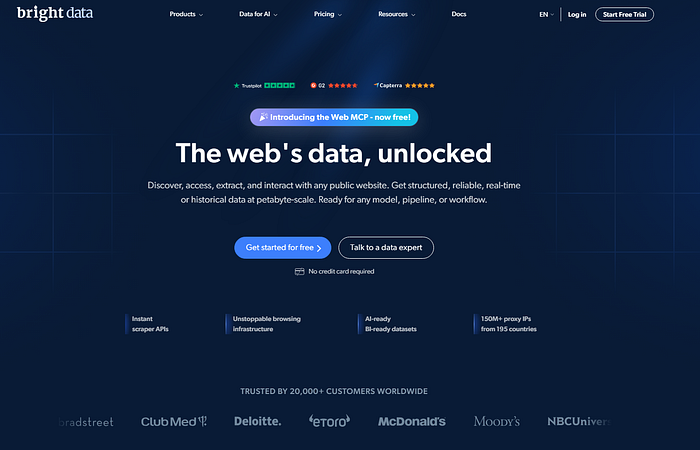
Bright Data’s website
Bright Data stands out as the premier travel data provider in 2025, offering unparalleled coverage, reliability, and compliance. Unlike traditional GDS providers or limited APIs, Bright Data delivers comprehensive travel data from virtually any public source on the web, including airline websites, OTA platforms, hotel booking sites, review platforms, and travel aggregators. The platform is fully compliant with GDPR, CCPA, and international data protection regulations, making it the safest choice for businesses operating globally.
What sets Bright Data apart is its ability to collect structured, real-time travel data at scale without the limitations of traditional APIs. Whether you need airfare pricing across hundreds of routes, hotel availability data, customer reviews, competitive intelligence, or destination trends, Bright Data’s infrastructure ensures 99.9% uptime and accurate data delivery. The platform’s ethical approach means it only collects publicly available information while respecting robots.txt and website terms of service.
Key Features:
- Comprehensive Coverage: Access travel data from over 20,000 travel websites, including airlines, OTAs, hotels, car rental services, and review platforms globally.
- Real-Time Data: Collect live pricing, availability, and booking data updated in real-time for dynamic pricing strategies.
- Data Compliance: Full compliance with GDPR, CCPA, and other international data protection laws, with transparent data collection practices.
- Global Proxy Network: The world’s largest proxy network with 72M residential IPs ensures reliable access to geo-restricted travel data.
- Structured Data Delivery: Receive clean, structured data in your preferred format (JSON, CSV, Excel) ready for immediate analysis.
- Customizable Solutions: Tailor data collection to your specific needs, from flight schedules to hotel amenities and customer sentiment analysis.
- 99.9% Uptime: Enterprise-grade infrastructure guarantees consistent data flow for mission-critical operations.
- No Rate Limits: Unlike traditional APIs, collect unlimited data without throttling or request caps.
Pros:
- Largest coverage of travel data sources globally
- No API restrictions or rate limiting
- Fully compliant with international data laws
- Real-time data collection at scale
- Highly customizable for specific use cases
- 99.9% uptime SLA
- Expert support team available 24/7
- Can access geo-restricted content
Cons:
- Requires integration setup (though support is provided)
- Premium pricing reflects enterprise-quality service
Pricing: Bright Data offers flexible pricing models:
- Pay-as-you-go: Starting at $1.50/1K records
- Growth: $0.95/1K records with volume discounts
- Business: $0.84/1K records with dedicated support
- Premium: $0.79/1K records with SLA guarantees
Use coupon code APIS25 for 25% off your first purchase.
Best For: OTAs, travel agencies, airlines, hotels, price comparison platforms, travel tech companies, market research firms, and any business requiring comprehensive, compliant travel data at scale.
2. Amadeus
Amadeus’s website
Amadeus is one of the largest global distribution systems (GDS) in the travel industry, providing access to extensive airline, hotel, car rental, and travel content inventory. Founded in 1987, Amadeus has built a comprehensive ecosystem that powers bookings for travel agencies, airlines, and travel companies worldwide. The platform offers both content distribution and advanced analytics capabilities.
Amadeus is particularly strong in European markets and offers deep integration with airline reservation systems. The platform provides historical and predictive travel data, making it valuable for market analysis and demand forecasting.
Key Features:
- Extensive Inventory: Access to 490 airlines, 150,000 hotels, and 30 car rental companies globally.
- Advanced Analytics: Powerful business intelligence tools for market analysis and forecasting.
- GDS Integration: Direct connections to airline reservation systems and hotel central reservation systems.
- API Access: RESTful APIs for flight search, booking, hotel shopping, and destination content.
- Historical Data: Access to years of booking trends and travel patterns.
Pros:
- Massive global inventory coverage
- Strong presence in European markets
- Comprehensive analytics and BI tools
- Reliable booking capabilities
- Established industry player
Cons:
- Complex pricing structure with multiple fees
- Steep learning curve for implementation
- Can be expensive for small businesses
- Limited customization outside standard offerings
- Requires certification for many features
Pricing: Amadeus uses a complex pricing model based on:
- Monthly subscription fees ($500-$5,000 depending on services)
- Per-transaction fees ($0.50-$3.00 per booking)
- API access fees (custom quotes starting from $10,000/year)
- Additional charges for premium content and analytics
Best For: Large travel agencies, airlines, established OTAs with high booking volumes, and enterprises needing traditional GDS integration.
3. Sabre

Sabre’s website
Sabre is one of the original GDS providers and remains a dominant force in the travel technology space, particularly in North America. The platform offers extensive travel content, booking capabilities, and market intelligence. Sabre processes over $260 billion in travel spending annually and connects buyers and sellers across the global travel ecosystem.
Sabre’s strength lies in its deep airline relationships and comprehensive booking intelligence. The platform offers sophisticated data analytics tools and market insights that help businesses understand travel patterns and optimize their operations.
Key Features:
- Broad Content Coverage: Access to 400 airlines, 175,000 hotel properties, 200 tour operators, and 30 car rental brands.
- Market Intelligence: Advanced analytics platform with predictive insights and demand forecasting.
- Booking Platform: Full-service booking capabilities for flights, hotels, cars, and travel packages.
- Developer APIs: Modern RESTful APIs for flight search, booking, hotel content, and traveler profiles.
- Historical Analytics: Decades of travel booking data for trend analysis.
Pros:
- Strong North American market presence
- Comprehensive booking intelligence
- Robust API documentation
- Reliable infrastructure
- Extensive hotel content
Cons:
- Premium pricing structure
- Complex integration requirements
- High initial setup costs
- Learning curve for full platform utilization
- Transaction fees can add up quickly
Pricing: Sabre pricing includes:
- Platform subscription: $1,000-$10,000 per month
- Per-transaction fees: $0.75-$4.00 per booking
- API access: Custom enterprise quotes (typically $15,000 /year)
- Additional fees for premium content and analytics tools
Best For: Travel management companies, corporate travel departments, large OTAs, and enterprises with significant booking volumes focused on North American markets.
4. OAG (Official Airline Guide)
OAG’s website
OAG specializes in aviation data and intelligence, providing the most comprehensive and accurate flight schedule information in the industry. Founded in 1929, OAG has nearly a century of experience collecting and analyzing aviation data. The platform focuses specifically on airline schedules, on-time performance, route analytics, and airport data.
OAG is the go-to source for businesses that need detailed aviation intelligence rather than booking capabilities. Their data powers flight comparison engines, aviation analytics platforms, and airline competitive intelligence tools.
Key Features:
- Flight Schedules: Complete schedule data for 900 airlines covering 4,000 airports worldwide.
- On-Time Performance: Historical and real-time data on flight delays and cancellations.
- Route Analytics: Comprehensive route intelligence including capacity, frequency, and competitive analysis.
- Aviation Intelligence: Market insights, traffic data, and demand forecasting for aviation industry.
- API Access: RESTful APIs for schedule data, flight status, and route information.
Pros:
- Most accurate aviation schedule data
- Comprehensive on-time performance metrics
- Specialized aviation expertise
- Clean, structured data feeds
- Historical data going back decades
Cons:
- Limited to aviation data only (no hotels or other travel content)
- No booking capabilities
- Premium pricing for specialized data
- Not suitable for businesses needing multi-modal travel data
- Can be overkill for simple flight search needs
Pricing: OAG offers tiered pricing:
- Basic Schedule Data: Starting at $2,000-$5,000 per month
- Premium Analytics: $10,000-$25,000 per month
- Enterprise Solutions: Custom quotes based on data volume and features
- API Access: Typically bundled with subscription or priced separately from $15,000/year
Best For: Airlines, airports, aviation consultants, flight tracking services, aviation analytics platforms, and businesses focused specifically on air travel intelligence.
5. Skyscanner API

Skyscanner’s API website
Skyscanner, one of the world’s leading flight comparison platforms, offers API access to its comprehensive flight pricing and search capabilities. The Skyscanner API aggregates real-time flight data from hundreds of airlines and OTAs, making it an excellent choice for businesses building flight comparison tools or travel search platforms.
The platform is known for its user-friendly API design and flexible search options, including “everywhere” searches and flexible date queries. Skyscanner processes over 100 million flight queries per month, providing valuable market insights.
Key Features:
- Flight Price Comparison: Real-time pricing from 1,200 airlines and travel partners worldwide.
- Flexible Search: Support for one-way, round-trip, multi-city, and flexible date searches.
- Live Pricing: Real-time availability and pricing updates.
- Browse API: Explore flight prices by destination, date, or budget without specific parameters.
- Referral Model: Earn revenue through flight bookings via affiliate partnerships.
Pros:
- Comprehensive flight price coverage
- User-friendly API with good documentation
- Flexible search capabilities
- Revenue sharing opportunities
- No cost for basic API access (affiliate model)
- Fast response times
Cons:
- Primarily focused on flights (limited other travel content)
- No direct booking through API (redirects to partners)
- Rate limits on free tiers
- Data access depends on partnership agreements
- Limited historical data access
- Less suitable for enterprise-scale operations
Pricing: Skyscanner offers several access levels:
- Travel Affiliate Program: Free API access with revenue sharing on bookings (typically 50–70% of commission)
- API Partners: Limited free access with rate limits (1,000 requests/day)
- Commercial License: Custom quotes for higher volume (starting around $20,000/year)
- Enterprise Solutions: Negotiated pricing for white-label and high-volume implementations
Best For: Travel comparison startups, travel blogs and content sites, smaller OTAs, affiliate marketers, and businesses focused primarily on flight comparison and search.
6. Expedia Partner Solutions (EPS)
Expedia’s Partner Solutions website
Expedia Partner Solutions (formerly Expedia Affiliate Network) provides access to Expedia’s vast inventory of hotels, vacation rentals, flights, car rentals, and activities. As part of the Expedia Group, EPS offers one of the world’s largest accommodation inventories with over 700,000 properties globally.
The platform is particularly strong for businesses focusing on hotel bookings and accommodation content. EPS provides both affiliate APIs for referral partnerships and supply APIs for direct integration with booking capabilities.
Key Features:
- Massive Hotel Inventory: Access to 700,000 properties including hotels, vacation rentals, apartments, and unique stays.
- Multi-Product Content: Hotels, flights, car rentals, activities, and vacation packages.
- Booking Capabilities: Full booking integration with payment processing and customer support.
- Rich Content: Detailed property descriptions, images, amenities, and verified guest reviews.
- Revenue Opportunities: Competitive commission structure for bookings.
Pros:
- Largest hotel inventory available
- Comprehensive property content and images
- Strong brand recognition
- Reliable booking infrastructure
- Marketing support and resources
- Multiple revenue models available
Cons:
- Competitive commission splits
- Strict brand guidelines and usage restrictions
- Limited customization of user experience
- Can be challenging for smaller partners to get approved
- Rate parity requirements
- Limited access to raw data for analytics
Pricing: Expedia Partner Solutions operates on multiple models:
- Affiliate Program: Free API access with commission earnings (typically 2–6% of booking value)
- Partner Collect: Revenue sharing model with Expedia collecting payment
- Merchant Model: Buy wholesale rates and set your own margins
- Connectivity Partners: Custom enterprise agreements (requiring significant volume)
Best For: Travel agencies, hotel-focused OTAs, travel content websites, accommodation comparison platforms, and businesses seeking comprehensive hotel inventory with booking capabilities.
7. Travel Compositor
Travel Compositor’s website
Travel Compositor is a travel content aggregation platform that consolidates data from multiple GDS systems, low-cost carriers (LCCs), and direct hotel connections into a single unified API. This approach solves a major pain point in travel technology: the need to integrate with multiple disparate systems to access comprehensive travel content.
Travel Compositor is particularly valuable for businesses that need broad content coverage without the complexity of managing multiple GDS relationships and technical integrations. The platform normalizes data formats and provides a consistent interface regardless of the underlying source.
Key Features:
- Multi-Source Aggregation: Combines content from GDS systems (Amadeus, Sabre, Travelport), LCCs, hotel chains, and direct connections.
- Unified API: Single integration point for flights, hotels, car rentals, and travel services.
- Data Normalization: Consistent data structure regardless of source system.
- Smart Shopping: Intelligent search algorithms that query optimal sources for best results.
- Caching and Optimization: Performance optimization for faster search results.
Pros:
- Single integration for multiple content sources
- Consistent data format across sources
- Access to LCC content often missing from GDS
- Reduces integration complexity
- Performance optimization built-in
- Flexible deployment options
Cons:
- Additional layer between you and content sources
- Monthly fees plus per-transaction costs
- May not always have newest features from source systems
- Limited compared to working directly with providers
- Smaller company with less market presence
- Some advanced features may not be supported
Pricing: Travel Compositor pricing structure:
- Setup Fee: $5,000-$15,000 one-time implementation
- Monthly Platform Fee: $1,500-$5,000 depending on modules
- Transaction Fees: $0.20-$1.50 per booking depending on content type
- Enterprise Plans: Custom pricing for high-volume operations
Best For: Mid-sized travel agencies, growing OTAs, travel management companies seeking simplified integration, and businesses needing content from multiple sources without managing multiple relationships.
8. IATA (International Air Transport Association)

IATA’s website
IATA is the official trade association for the world’s airlines, and provides authoritative aviation industry data and standards. While not a travel data provider in the traditional sense, IATA offers critical reference data that powers much of the travel industry, including airport codes, airline codes, country codes, aircraft types, and industry standards.
IATA data is essential for any travel technology platform that needs accurate, standardized reference information. The organization also provides valuable industry reports, market statistics, and economic analysis for the aviation sector.
Key Features:
- Official Codes Database: Authoritative airport (IATA/ICAO) codes, airline codes, and country codes.
- Industry Standards: Data standards and specifications used across the travel industry.
- Market Intelligence: Aviation industry statistics, passenger traffic data, and market analysis reports.
- Regulatory Information: Access to international travel regulations, visa requirements, and travel restrictions.
- Aircraft Data: Comprehensive aircraft type information and specifications.
Pros:
- Official, authoritative industry data
- Industry standard reference information
- Comprehensive aviation statistics
- Regularly updated regulatory information
- Essential for travel technology compliance
- Respected industry organization
Cons:
- Limited to reference and statistical data (no booking content)
- No real-time pricing or availability
- Expensive for small businesses
- Much data available only to IATA members
- Not suitable as primary travel data source
- Focused exclusively on aviation
Pricing: IATA data services pricing:
- Basic Codes Database: $500-$2,000 per year
- Premium Reference Data: $5,000-$15,000 per year
- Market Intelligence Reports: $3,000-$10,000 per report
- IATA Membership: Required for many services ($1,500-$15,000 annually depending on organization size)
- Enterprise Solutions: Custom pricing for comprehensive data access
Best For: Airlines, airports, travel technology providers needing authoritative reference data, aviation analytics firms, regulatory compliance, and businesses building travel platforms requiring industry-standard codes and specifications.
How to Choose the Right Travel Data Provider
Selecting the optimal travel data provider depends on several critical factors:
1. Data Coverage Requirements
- Comprehensive Multi-Source: Choose Bright Data for unlimited access to any public travel data source
- Traditional GDS Content: Consider Amadeus or Sabre for established airline and hotel inventory
- Aviation-Specific: OAG for detailed flight schedule and performance data
- Accommodation-Focused: Expedia Partner Solutions for extensive hotel inventory
2. Technical Capabilities
- Flexibility and Customization: Bright Data offers the most flexibility for custom data requirements
- Standardized APIs: Traditional providers offer structured APIs with documentation
- Integration Complexity: Consider your technical team’s capabilities and integration timeline
3. Compliance and Legal Considerations
- Data Protection: Ensure provider complies with GDPR, CCPA, and relevant regulations
- Ethical Collection: Verify transparent data collection practices
- Terms of Service: Understand usage restrictions and licensing terms
- Bright Data leads in compliance: Full transparency and legal compliance guarantees
4. Budget Constraints
- Enterprise Budget: Comprehensive solutions like Bright Data, Amadeus, or Sabre
- Mid-Market: Travel Compositor, Expedia Partner Solutions with commission models
- Startup/Small Business: Skyscanner API affiliate program, limited free tiers
5. Scale and Performance
- High Volume: Bright Data’s infrastructure supports unlimited scale with 99.9% uptime
- Medium Volume: Traditional APIs with tiered pricing based on request volumes
- Low Volume: Affiliate programs and free tiers may suffice
6. Data Freshness Requirements
-
- Real-Time Pricing: Bright Data, Skyscanner, and GDS providers offer live data
- Historical Analysis: OAG, IATA, and Bright Data provide extensive historical datasets
- Predictive Analytics: Amadeus and Sabre offer forecasting tools
7. Geographic Focus
- Global Coverage: Bright Data provides unrestricted worldwide access
- Regional Strengths: Sabre (North America), Amadeus (Europe), specific regional providers
Comparison Table: Travel Data Providers at a Glance
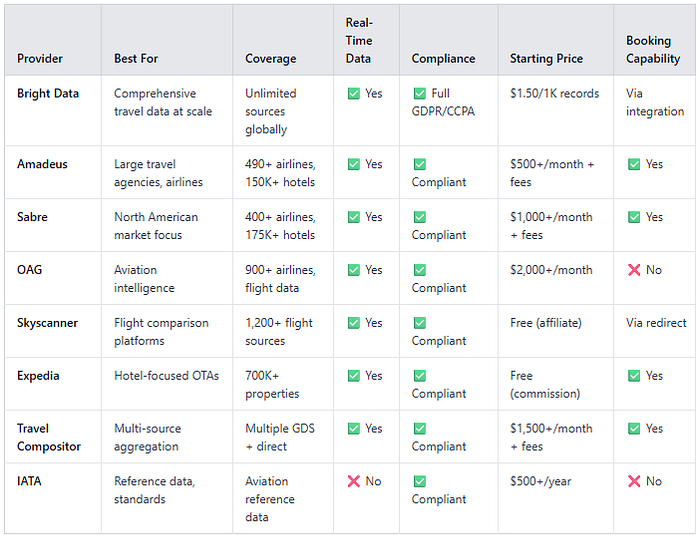
Final comparison of all providers
Industry Use Cases and Recommendations
For Online Travel Agencies (OTAs)
Recommended: Bright Data provides unlimited access to competitor pricing, real-time availability across all travel sources, and customer review data for comprehensive market intelligence without API limitations.
For Airlines
Recommended: Bright Data OAG combination offers competitive intelligence from all public sources plus specialized aviation analytics for route planning and performance benchmarking.
For Hotels and Accommodation Providers
Recommended: Bright Data enables monitoring of competitor pricing across all OTA platforms, direct competitor websites, and review platforms for comprehensive market positioning.
For Price Comparison Platforms
Recommended: Bright Data provides unrestricted access to pricing data from any travel website, enabling true comprehensive comparison without being limited to API partnerships.
For Travel Market Research
Recommended: Bright Data offers the broadest data collection capabilities for analyzing trends, consumer sentiment, pricing patterns, and competitive dynamics across the entire travel ecosystem.
For Travel Management Companies
Recommended: Sabre or Amadeus for booking capabilities combined with Bright Data for market intelligence and supplier negotiations.
For Aviation Analytics
Recommended: OAG Bright Data combines specialized aviation data with broader market intelligence and competitive analysis capabilities.
Emerging Trends in Travel Data (2025)
The travel data landscape continues to evolve rapidly:
- AI-Powered Insights: Travel data providers increasingly incorporate machine learning for predictive analytics, demand forecasting, and personalization.
- Sustainability Data: Growing demand for carbon emissions data, sustainable travel options, and ESG-compliant travel information.
- Real-Time Dynamic Pricing: Microsecond-level price updates enabling sophisticated revenue management and competitive response.
- Alternative Accommodation Data: Expansion beyond traditional hotels to include vacation rentals, unique stays, and long-term accommodation options.
- Ancillary Services Integration: Comprehensive data covering not just core travel products but activities, experiences, dining, and local services.
- Voice and Conversational Data: Structuring travel data for voice assistants and conversational AI interfaces.
- Blockchain and Verification: Emerging use of blockchain for verified reviews, booking confirmation, and data provenance.
- Privacy-First Data Collection: Increased emphasis on privacy-compliant data collection methods and transparent sourcing.
There are a few providers that stay on top of these trends, continuously expanding capabilities to meet evolving market demands while maintaining strict compliance and ethical standards.
Conclusion
Choosing the right travel data provider is crucial for success in today’s competitive travel industry. While traditional GDS providers like Amadeus and Sabre offer established solutions with booking capabilities, and specialized providers like OAG excel in aviation data, Bright Data comes up as the clear leader for businesses requiring flexible, and compliant travel data at scale.
If you have any questions for me, please let me know in the comments!